What is RAIN RFID? UHF RFID Technology Explained
Learn what RAIN RFID is, how UHF RFID systems work, and why antenna selection is critical. Explore Times-7's high-performance RFID antenna portfolio and custom design services.
Blogs
May 25, 2026

Learn what RAIN RFID is, how UHF RFID systems work, and why antenna selection is critical. Explore Times-7's high-performance RFID antenna portfolio and custom design services.
Blogs
May 25, 2026
The name RAIN refers to the key attributes of the technology:
Ultra High Frequency (UHF) RFID has become a foundational technology for tracking, traceability, and automation across industries. RAIN RFID is the global brand name for passive UHF RFID built on the GS1 EPC Gen2 / ISO 18000-63 standard; in other words, RAIN is UHF RFID in its standardised, interoperable form. Among the different RFID technologies available today, it has emerged as the global standard for large-scale, item-level identification, and is now known globally simply as RAIN.
RAIN enables organisations to read hundreds or thousands of tagged items quickly and accurately, without a line of sight. It is designed for scale, speed, and reliability, making it ideal for applications such as retail inventory management, healthcare asset tracking, logistics, manufacturing, and industrial automation.
Because RAIN is governed by these global standards, interoperability is assured between tags, readers, and antennas from different vendors.
Understanding RFID Frequencies
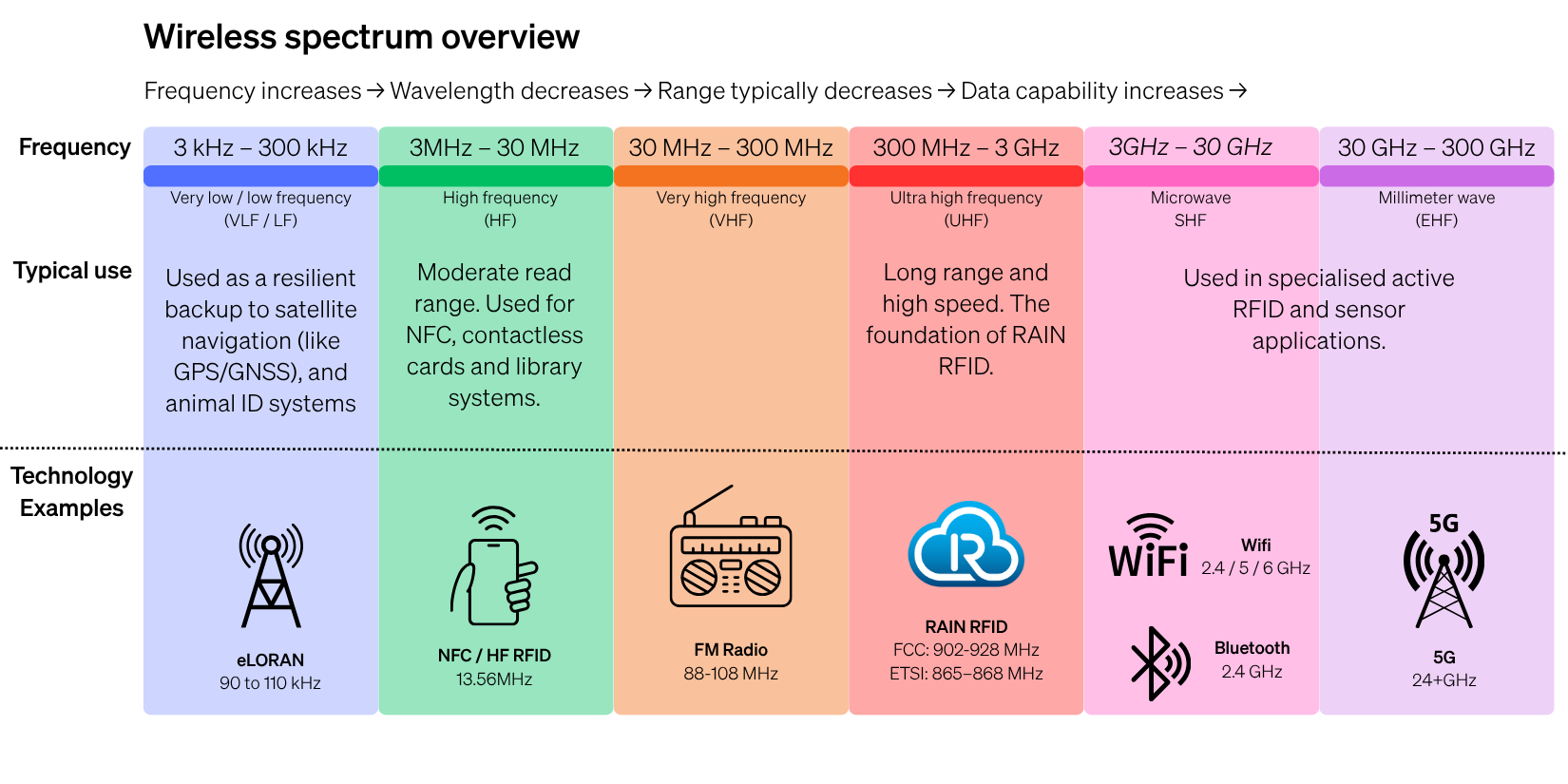
UHF RFID (Ultra-High Frequency) refers to radio frequencies between 300 MHz and 3 GHz. RAIN RFID operates within the UHF band, typically between 860–930 MHz, depending on regional regulations.
UHF is well suited to RFID because it offers:
Long read ranges, often several metres or more
Fast read rates for high-volume environments
Good performance for bulk item-level tagging
To help explain the frequency bands and the applications that fall within those bands, please see the graph below:
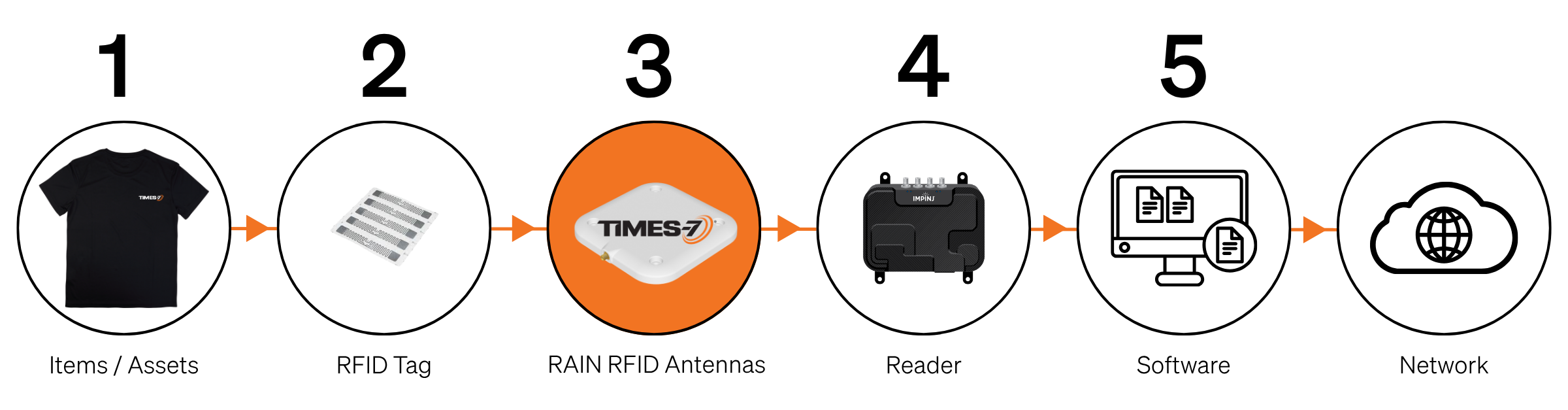
A successful RAIN RFID system depends on multiple hardware and software components working together seamlessly. Each plays a critical role in enabling reliable identification, tracking, and data capture at scale.
For clarity, let’s explore how these components function in a real-world retail setting, tracking a t-shirt through its journey from warehouse to customer.
To see how this works in practice, consider a retail scenario: tracking a t-shirt from fulfilment centre to point of sale.
What's being tracked
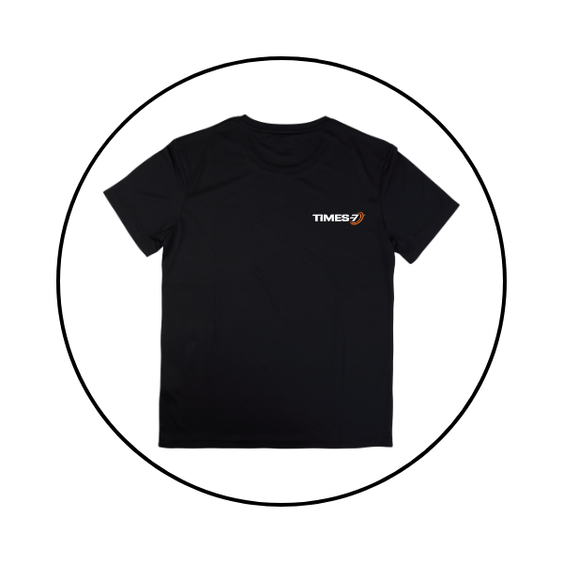
In this example, the asset is a retail item: a t-shirt with a unique SKU, forming part of the RFID-tagged retail inventory. These items move from warehouses and fulfilment centres to stores, where they travel from back of house to front of house, and can move between locations in-store (for example, from a shelf or rack to a fitting room, and back again), before reaching the point of sale, being purchased, and leaving the store.
All these movements provide valuable data: item movement patterns, stock turnover rate, product availability, shrinkage, and more. For this data to be captured and acted upon, each item needs to be RFID tagged, which we cover in the next section.
Giving assets a digital identity
An RFID tag contains:
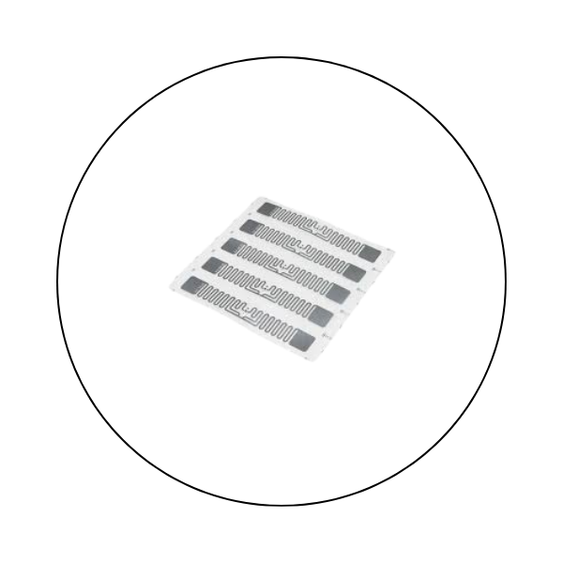
Most RAIN RFID tags are passive. They have no battery and are powered by the energy transmitted from the reader antenna. Tags can be attached to tools, garments, products, or assets, quietly turning physical items into digital data points.
In our retail example, the t-shirt is tagged at the point of manufacture or during inbound processing at the warehouse. The tag is typically a small inlay sewn into the care label or attached to a hang tag. From this moment, that specific t-shirt has its own unique EPC, a digital identity that travels with it through every stage of the supply chain.

Shaping the read zone
RFID antennas are the interface between the reader and the tagged item. They transmit and receive RF signals and define exactly where tags are detected.
Antennas influence system performance in three decisive ways:
In a retail deployment, antennas are positioned at multiple points along the t-shirt's journey. At the fulfilment centre, dock door antennas read hundreds of tagged garments simultaneously as outbound shipments move through, confirming despatch without manual scanning. In store, ceiling-mounted or overhead antennas monitor the sales floor continuously, detecting when the t-shirt moves from the stockroom to the floor, or from a rack to a fitting room. At the point of sale, a near-field antenna confirms the item at checkout before the transaction completes.
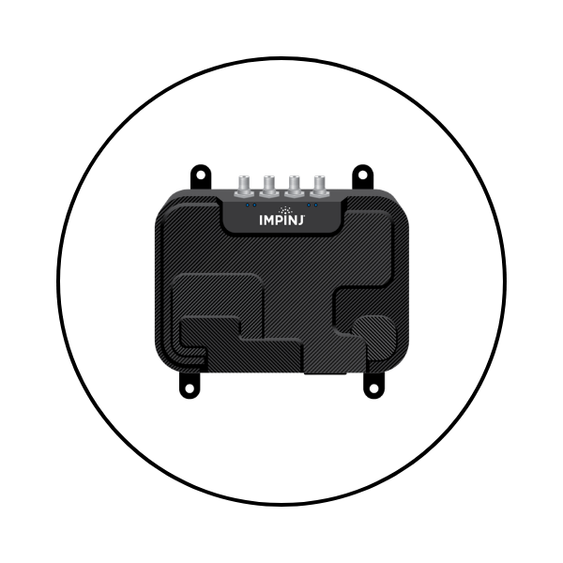
The system brain
The RFID reader controls the flow of communication between all system components. It performs three essential functions:
Note: While readers are often chosen based on features and connectivity, their true performance is only realised when paired with the right antenna.
Throughout the t-shirt's journey, readers are working continuously in the background. At the warehouse, a fixed reader connected to dock door antennas captures each outbound shipment. In store, fixed readers connected to ceiling antennas poll at regular intervals, logging every location change. At checkout, a reader confirms the tag read and triggers the POS transaction. At each stage, the reader manages signal collisions from nearby tagged items and passes clean, structured data upstream to software.

Turning reads into insights
The final piece of the system is software, which captures, filters and interprets tag data.
In a retail environment, software integrates with systems such as:
It translates raw data into actionable insights. This data is typically stored and accessed via the cloud or a local network, supporting real-time decision-making.
For the t-shirt, this means the software knows when it left the warehouse, when it arrived in store, how long it sat in the stockroom before reaching the sales floor, whether it visited a fitting room, and when it was purchased. Every event is a timestamped data point, building a complete picture of stock movement and availability.
Stock counts that once required manual handheld scanning can be replaced with continuous automated reads. Shrinkage events are flagged automatically when a tag is detected leaving the store without a corresponding POS transaction. Replenishment triggers fire when floor stock drops below a set threshold. The t-shirt's journey from fulfilment centre to customer becomes fully visible and, more importantly, fully actionable.
Depending on the application, RAIN RFID systems may also include:
If you are designing a RAIN RFID solution, whether in healthcare, logistics or retail, understanding how these components interact is essential. Ensuring the right antenna is selected for your environment often determines the success or failure of the entire system.
Times-7 is a specialist RFID antenna manufacturer with a proven range of RAIN RFID reader antennas designed for real-world performance across logistics, retail, and industrial environments.
The product lineup spans multiple form factors, from slim-line low-profile antennas to circular and linear polarised options, multiport and multipatch configurations, and housings rated across various IP ratings for indoor, outdoor, and washdown environments, giving system integrators the right antenna for every application.
From RFID ceiling mount antennas for wide-area warehouse scanning to RFID dock door antennas that automate inbound and outbound shipment verification, through to RFID portals and RFID tunnels for high-throughput conveyor and sortation systems, every product is engineered around the deployment. The range also includes antennas optimised for on-surface reads on metal surfaces and liquids, addressing one of the most challenging scenarios in RFID deployment, with IP69K rated options built to perform where standard equipment falls short.
Compact OEM and embedded RFID antenna options support manufacturers building RFID capability directly into equipment and infrastructure. Across every environment and application, Times-7 antennas deliver the consistent read reliability and coverage that today's fixed RFID infrastructure depends on. And if we don't have an antenna to meet a unique speciation, we can design and manufacture one.
The GS1 UHF RFID Air Interface Protocol standard defines the communication rules between UHF RFID readers and tags for reliable, interoperable supply chain item identification and tracking.
ISO 18000-63 specifies the air interface communications protocol for UHF RFID systems operating in the 860-960 MHz frequency band for item management applications.
The RAIN Alliance is a global industry organization dedicated to driving the adoption and standardization of UHF RFID technology (branded as RAIN) to connect everyday items to the internet for smarter supply chains and IoT applications.


